
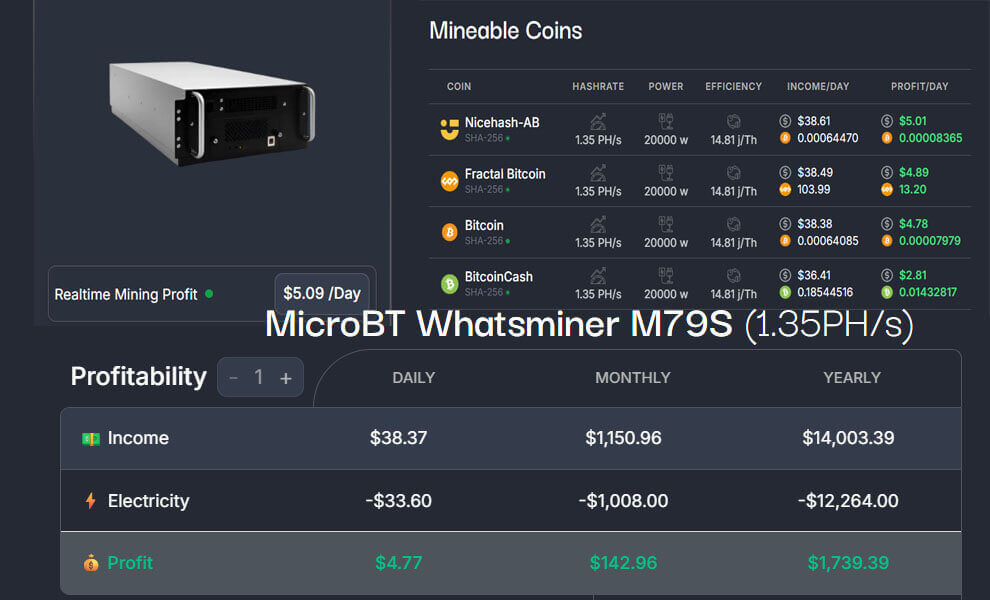
The MicroBT Whatsminer M79S, a next-generation industrial Bitcoin ASIC miner created to satisfy the growing needs of big mining businesses, leads this invention. Designed for peak efficiency and cost-effectiveness, the M79S marks a major advance in cryptocurrency mining equipment. Its December 2025 debut marks a fresh age for professional miners trying to maximize their business in an increasingly cutthroat industry.
The remarkable hashrate of 1. 35 PH/s, equal to 1,350 TH/s, sets the Whatsminer M79S apart. Its optimization for the SHA-256 algorithm helps to produce this enormous processing power, therefore making it especially well-suited for mining Bitcoin (BTC) and other SHA-256 coins including Bitcoin Cash (BCH), Bitcoin SV (BSV), and eCash (XEC). In the cutthroat world of Bitcoin mining, when network complexity inevitably increases, such a high hashrate is essential for securing blocks and producing income.
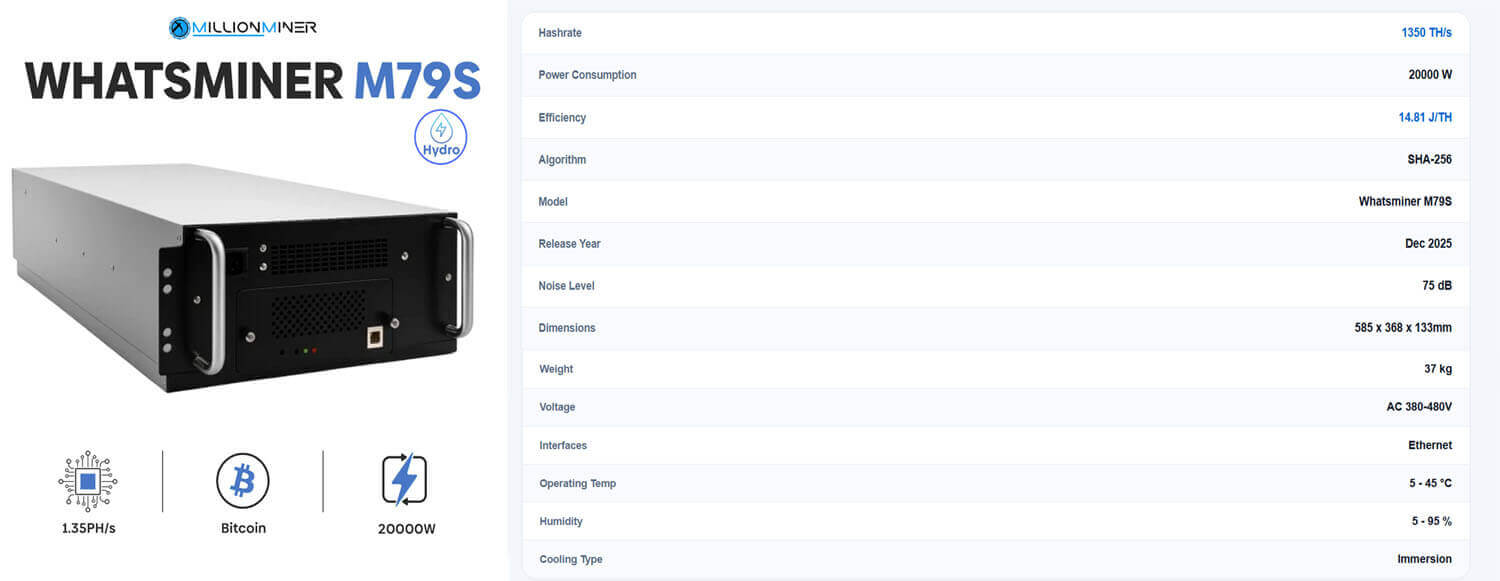
The M79S’s energy efficiency is also remarkable, with a rating of 14. 81 J/TH. For profit, this indicator is essential since electricity prices make up a sizable part of operational expenditures for any mining farm. The M79S greatly lowers its operational footprint by lowering the energy used per terahash, therefore increasing its economic viability, particularly in areas with greater electricity prices. Its advanced hydro cooling system is mostly responsible for this efficiency. Traditional air-cooled miners can have trouble getting rid of heat when they are used a lot for a long time. Liquid cooling, on the other hand, makes sure that the miner works well, lowers the temperature inside, and ultimately makes the hardware last longer. For industrial applications where uptime and longevity are critical, this is a major consideration.
Designed for Industrial Scale
The average home hobbyist is not meant to use the Whatsminer M79S. It is obvious that with a significant power consumption of 20,000W and a weight of around 26 kg, it is designed for professional data centres and major industrial mining operations. The powerful construction and cutting-edge cooling system are designed to handle the demands of continuous operation in harsh surroundings. Although the power usage may appear substantial, its outstanding efficiency when combined with access to low-cost power or via commercial hosting services makes it an extremely appealing alternative. The M79S offers a great chance to increase earnings for mining companies that can get power prices under $0. 07 per kWh.
With an electricity cost of $0. 07 per kWh, the projected profitability indicates a daily profit of $4. 73, or an annual income of about $1,725. 45. It is important to note, though, that these numbers are merely projections. The real profit will differ depending on a number of shifting elements. The genuine return on investment in the actual world is much influenced by the price of Bitcoin, the always rising network difficulty, mining pool fees, and, of course, the actual power expenses at any given area. Therefore, prospective purchasers have to do a lot of research, taking into account their particular operational surroundings and the state of the market right now.
For expert cryptocurrency miners, the MicroBT Whatsminer M79S stands out as a high-quality option. Its leading hashrate and great energy efficiency make it an ideal tool for large-scale Bitcoin mining. The sophisticated hydro cooling technology improves its allure even more by guaranteeing dependability and longevity, essential for maintaining profitability over time. Although the initial investment and power requirements demand a major commitment, miners with access to cheap electricity may utilize the M79S to achieve a significant competitive edge.
The ultimate choice to purchase the Whatsminer M79S depends on a thorough analysis of its possible profitability versus an individual miner’s particular circumstances. It is absolutely essential to do extensive research on local power prices, latest Bitcoin market trends, and estimates for network difficulty. The M79S is a powerful piece of equipment for those who can meet these requirements, and it can help them achieve great success in the changing world of digital asset mining.
The MicroBT Whatsminer M79S is evidence of the cryptocurrency mining sector’s ongoing quest of efficiency and performance; it is more than simply a piece of hardware. Professional miners find it appealing due to its remarkable specifications, especially its great hashrate and low energy consumption. The sophisticated hydro cooling system overcomes a major obstacle to continuous high-performance mining by guaranteeing operational stability and hardware longevity. Although electricity costs and outside market forces are clearly related to profitability, the M79S is clearly built to maximize profits for those working at an industrial level. Devices such as the Whatsminer M79S will be absolutely essential in influencing the future of Bitcoin mining as the cryptocurrency scene develops quickly, allowing more efficient and strong activities for the foreseeable future.
Optimized for Bitcoin Dominance in a SHA-256 Landscape
With an astounding 1. 35 PH/s hashrate, the Whatsminer M79S marks a major improvement in cryptocurrency mining gear. Although its fundamental design allows it to mine several cryptocurrencies using the SHA-256 hashing algorithm, its outstanding processing capability and efficiency make it especially fit for Bitcoin (BTC) mining. The M79S has many uses, but this essay will look at why Bitcoin mining is still its main optimisation. It will do this by looking at the features of Bitcoin and other SHA-256 cryptocurrencies and by stressing the reasons why BTC is still so popular for professional mining.
Bitcoin: The Apex Miner Target
With a market capitalization of more than $500 billion, Bitcoin, founded in 2009, is the clear leader and biggest cryptocurrency. Its inventor Satoshi Nakamoto unveiled a decentralized digital currency free from the power of conventional financial organizations. Together with its strong security and extensive acceptance, this basic tenet of decentralization has helped Bitcoin to be the most expensive cryptocurrency. Thus, sophisticated mining activities all throughout the world center mostly on it. It is essential to the functioning of the network, not just for profit that one mines Bitcoin. It entails confirming transactions, protecting the dispersed ledger (blockchain), and paying miners in newly produced Bitcoins and transaction costs. For those who own high-performance mining equipment such as the Whatsminer M79S, BTC’s unmatched market worth and liquidity make it the most logical and profitable alternative.
Exploring Other SHA-256 Alternatives
Although Bitcoin is the main target, the Whatsminer M79S may mine other cryptocurrencies thanks to its SHA-256 algorithm. Launched in 2017, Bitcoin Cash (BCH) is the result of a hard fork of Bitcoin aiming to increase transaction capacity. BCH hopes to handle more transactions per second at reduced fees by using bigger block sizes. The M79S may mine BCH without hardware changes since it shares the SHA-256 algorithm. Based on changing market circumstances and profit, some miners deliberately alternate between BTC and BCH.
Another important fork of Bitcoin is Bitcoin SV (BSV), which first appeared in 2018. Its supporters advocate for extremely huge block sizes to enable business-level applications and high transaction throughput, therefore advocating a return to what they view as the original Bitcoin protocol. BSV is a suitable mining choice for the M79S when mining rewards are high, just like BTC and BCH rely on SHA-256.
Designed to address scalability and transaction speed, eCash (XEC), the successor to Bitcoin ABC, seeks to unite Bitcoin’s security with capabilities improving digital payment accessibility and speed. Using the SHA-256 algorithm means the M79S may be aimed at XEC mining should its profitability grow appealing.
Early cryptocurrency Peercoin (PPC) from 2012 used a hybrid consensus mechanism combining Proof of Work (PoW) with Proof of Stake (PoS). Though staking is now the main security feature, SHA-256 mining is still supported, which lets ASIC miners like the M79S take part. Although Peercoin has a smaller market share than Bitcoin, some miners choose it as a long-term investment or as a diversification approach.
One of the earliest cryptocurrencies after Bitcoin, Namecoin (NMC) concentrates on decentralized domain name registration to allow for censorship-resistant “. bit” domains. Namecoin likewise uses SHA-256 and offers merged mining support. This provides miners a way to earn more incentives by enabling them to potentially earn NMC with Bitcoin without a major increase in electricity use.
The Whatsminer M79S may mine a plethora of less well-known SHA-256 cryptocurrencies beyond these well-known instances. Many mining pools are configured to automatically switch to the most profitable SHA-256 coin in real-time, enabling miners to maximize their profits.
Why Bitcoin Dominates M79S Mining
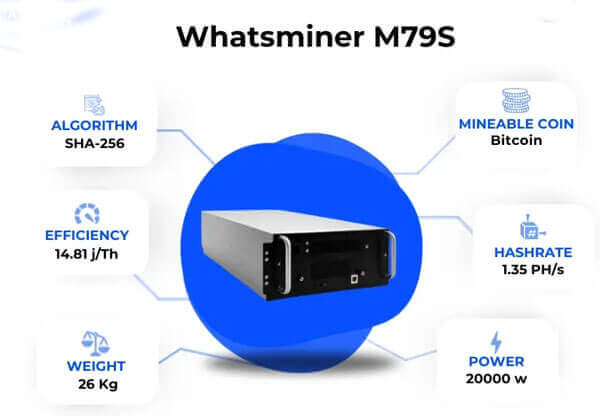
Although the Whatsminer M79S has the technical ability to mine a wide range of SHA-256 coins, most professional miners continue to focus on Bitcoin. Several important elements cause this inclination. Bitcoin has the most liquidity, which means it may be readily purchased and sold without appreciably affecting its price. With its vast support infrastructure, mining pools, and services, its mining ecosystem is the biggest and most developed. Moreover, Bitcoin is widely supported by exchanges, which makes it easier to trade mined assets without any hassle. Critically, BTC has the best long-term adoption trend, therefore suggesting continuous demand and value. Mining Bitcoin offers the best mix of profitability, operational stability, and long-term potential for professional mining companies when these benefits are paired with the M79S’s market-leading hashrate and energy efficiency.
Cryptocurrencies You Can Mine with the MicroBT Whatsminer M79S
The MicroBT Whatsminer M79S is built to mine cryptocurrencies that use the SHA-256 hashing algorithm. SHA-256 is one of the most secure and widely adopted proof-of-work algorithms in the blockchain industry, making it the standard for Bitcoin and several other established digital currencies.
Although the M79S is capable of mining multiple SHA-256 coins, its exceptional hashrate of 1.35 PH/s makes it primarily optimized for Bitcoin (BTC) mining, where profitability is generally the highest.
Bitcoin (BTC)
Bitcoin is the world’s first and largest cryptocurrency by market capitalization. Created in 2009 by the pseudonymous developer Satoshi Nakamoto, Bitcoin introduced decentralized digital money that operates without banks or governments. It remains the most valuable cryptocurrency and is the primary target for professional mining operations worldwide.
Mining Bitcoin validates network transactions, secures the blockchain, and rewards miners with newly minted BTC and transaction fees. Due to its high market value and liquidity, Bitcoin is the preferred cryptocurrency for most owners of the Whatsminer M79S.
Bitcoin Cash (BCH)
Bitcoin Cash was launched in 2017 as a hard fork of Bitcoin with the goal of increasing transaction capacity. By using larger block sizes, Bitcoin Cash aims to process more transactions per second while keeping transaction fees low.
Because BCH uses the same SHA-256 algorithm, the Whatsminer M79S can mine it without any hardware modifications. Some miners switch between BTC and BCH depending on market conditions and profitability.
Bitcoin SV (BSV)
Bitcoin SV (Satoshi Vision) is another Bitcoin fork that was created in 2018. Its developers focus on restoring what they believe to be the original Bitcoin protocol while supporting extremely large block sizes for enterprise applications and high transaction throughput.
Like Bitcoin and Bitcoin Cash, BSV relies on the SHA-256 algorithm, allowing the Whatsminer M79S to mine it efficiently whenever it offers favorable mining rewards.
eCash (XEC)
eCash (XEC) is the successor to Bitcoin ABC and is designed to improve scalability, transaction speed, and user experience. The project aims to combine the security of Bitcoin with features that make digital payments faster and more accessible.
Since eCash also uses SHA-256, miners can direct the Whatsminer M79S toward XEC mining if profitability becomes attractive.
Peercoin (PPC)
Peercoin is one of the earliest cryptocurrencies, launched in 2012. It introduced a hybrid consensus model that combines Proof of Work (PoW) and Proof of Stake (PoS). While staking now plays a significant role in securing the network, SHA-256 mining is still supported, allowing ASIC miners like the Whatsminer M79S to participate.
Although Peercoin has a smaller market compared to Bitcoin, some miners choose it for diversification or long-term investment strategies.
Namecoin (NMC)
Namecoin was one of the first cryptocurrencies created after Bitcoin and focuses on decentralized domain name registration. It allows users to register censorship-resistant “.bit” domains and store information on a blockchain without relying on centralized authorities.
Namecoin uses the SHA-256 algorithm and supports merged mining, which means miners can often earn NMC while mining Bitcoin without significantly increasing power consumption. This provides an opportunity to generate additional rewards alongside BTC.
Other SHA-256 Cryptocurrencies
In addition to the major coins listed above, the Whatsminer M79S can mine a variety of smaller cryptocurrencies that utilize the SHA-256 algorithm. Some mining pools automatically switch to the most profitable SHA-256 coin based on current market conditions, helping miners maximize their daily earnings.
Why Bitcoin Is Still the Best Choice
Although the Whatsminer M79S supports several SHA-256 cryptocurrencies, Bitcoin remains the primary mining target for most operators. BTC offers the highest liquidity, the largest mining ecosystem, widespread exchange support, and the strongest long-term adoption. Combined with the M79S’s industry-leading hashrate and energy efficiency, Bitcoin mining typically provides the best balance of profitability, stability, and long-term value for professional mining operations.
Summary of the MicroBT Whatsminer M79S
Specification Details
Algorithm SHA-256
Hashrate 1.35 PH/s (1,350 TH/s)
Power Cons 20,000W
Energy Efficiency 14.81 J/TH
Cooling Industrial Hydro Cooling
Noise Extremely Low (liquid cooled)
Weight 26 kg
Deployment Industrial Mining Farms
Hashrate 1.35 PH/s
The defining feature of the Whatsminer M79S is its extraordinary hashrate.
At 1.35 petahashes per second, the miner performs approximately:
1,350,000,000,000,000 hash calculations every second.
Compared to previous generations:
Miner Hashrate
Antminer S21 ~200 TH/s
Whatsminer M60 ~180 TH/s
Whatsminer M79S 1,350 TH/s
This represents a dramatic increase in computational power, making the M79S suitable for large-scale commercial mining facilities.
It is not recommended for:
Home miners
Hobbyists
Small residential mining setups
Users without access to inexpensive electricity
Tips to Maximize Profitability
If you’re considering the Whatsminer M79S, follow these best practices:
Secure electricity below $0.06/kWh whenever possible.
Join a reputable mining pool with competitive fees.
Maintain stable coolant temperatures to preserve efficiency.
Monitor Bitcoin network difficulty and market trends regularly.
Compare hosting providers if industrial infrastructure isn’t available.
Recalculate profitability before purchasing, as Bitcoin mining economics can change rapidly.

XFX Radeon RX 7900XT Gaming Graphics Card with 20GB GDDR6, AMD RDNA 3 RX-79TMBABF9
$699.99 (as of 11/03/2026 13:57 GMT +03:00 - More infoProduct prices and availability are accurate as of the date/time indicated and are subject to change. Any price and availability information displayed on [relevant Amazon Site(s), as applicable] at the time of purchase will apply to the purchase of this product.)
msi Gaming RTX 5070 Ti 16G Ventus 3X PZ OC Graphics Card (16GB GDDR7, 256-bit, Extreme Performance: 2482 MHz, DisplayPort x 3 2.1a, HDMI 2.1b, NVIDIA Blackwell Architecture)
$999.99 (as of 11/03/2026 13:57 GMT +03:00 - More infoProduct prices and availability are accurate as of the date/time indicated and are subject to change. Any price and availability information displayed on [relevant Amazon Site(s), as applicable] at the time of purchase will apply to the purchase of this product.)
GIGABYTE GeForce RTX 5060 Ti Gaming OC 16G Graphics Card, by NVIDIA,16GB 128-bit GDDR7, PCIe 5.0, WINDFORCE Cooling System,DisplayPort & HDMI - Video Output Interface,GV-N506TGAMING OC-16GD Video Card
$549.99 (as of 11/03/2026 13:57 GMT +03:00 - More infoProduct prices and availability are accurate as of the date/time indicated and are subject to change. Any price and availability information displayed on [relevant Amazon Site(s), as applicable] at the time of purchase will apply to the purchase of this product.)
GIGABYTE Radeon RX 9060 XT Gaming OC 16G Graphics Card, PCIe 5.0, 16GB GDDR6, GV-R9060XTGAMING OC-16GD Video Card
$459.99 (as of 11/03/2026 13:57 GMT +03:00 - More infoProduct prices and availability are accurate as of the date/time indicated and are subject to change. Any price and availability information displayed on [relevant Amazon Site(s), as applicable] at the time of purchase will apply to the purchase of this product.)
ASRock Intel Arc A380 Challenger ITX 6GB OC Graphics Card | Single Slot ITX | 2250 MHz | 6GB GDDR6 | DisplayPort 2.0 | HDMI 2.0b | 0dB Cooling | 8K Support | 500W | DirectX 12 Ultimate | PCle 4.0
$139.99 (as of 11/03/2026 13:57 GMT +03:00 - More infoProduct prices and availability are accurate as of the date/time indicated and are subject to change. Any price and availability information displayed on [relevant Amazon Site(s), as applicable] at the time of purchase will apply to the purchase of this product.)