

The Bitmain Antminer T9+ is an application-specific integrated circuit (ASIC) miner designed for mining Bitcoin. Released by Bitmain, a major player in the cryptocurrency mining hardware industry, the T9+ represents a generation of mining equipment aimed at optimizing the computational process required to secure the Bitcoin network and earn rewards. This device embodies the blend of hardware engineering and algorithmic efficiency necessary for profitable Bitcoin mining.
Core Components and Technical Specifications
At the heart of the Antminer T9+ is a Xilinx Zynq-7010 FPGA (Field-Programmable Gate Array) control board. This FPGA integrates a dual-core ARM Cortex-A9 processor, which manages the operations of the mining process. The FPGA’s programmability allows for firmware updates and optimizations, enhancing the miner’s performance and adaptability to changes in the Bitcoin protocol.
The Antminer T9+ incorporates 162 BM1387 chips. These chips are manufactured using TSMC’s 16nm FinFET technology. This technology enables a higher density of transistors on each chip, leading to increased computational power and improved energy efficiency compared to older mining hardware.
The Antminer T9+ was released in several batches, each offering different hash rates. These hash rates range from 10 TH/s (terahashes per second) to 12 TH/s. Hash rate measures the speed at which the miner can perform the calculations required to solve Bitcoin’s proof-of-work algorithm. Higher hash rates increase the miner’s chances of finding a block and earning the associated Bitcoin reward.
The power consumption of the Antminer T9+ varies depending on the specific batch. It ranges from 1406W to 1432W. Power efficacy is a critical metric for mining hardware, as it directly impacts profitability. The T9+ achieves power efficiency ratings between 0. 118J/GH and 0. 141J/GH (joules per gigahash). This indicates the amount of energy required to perform a given amount of computation.
The operation of the Antminer T9+ generates a significant amount of noise. The noise level is approximately 76 decibels. This level of noise requires miners to operate these devices in specialized environments, such as warehouses or soundproofed facilities, to mitigate noise pollution.
Impact on Bitcoin Mining
The Antminer T9+ significantly contributed to the landscape of Bitcoin mining by providing a balance of hash rate and energy efficiency. Its release allowed miners to increase their computational power. It also helped them manage electricity costs. This was particularly important during periods of increased mining difficulty and fluctuating Bitcoin prices.
The introduction of more efficient miners like the T9+ has led to a concentration of mining power among larger mining operations. These operations can afford the upfront investment in hardware and the ongoing costs of electricity and cooling. This trend has sparked discussions about the decentralization of the Bitcoin network and the potential risks associated with concentrated mining power.
Influential Contributions
While the Antminer T9+ is a product of Bitmain, several individuals have contributed to the broader field of Bitcoin mining and hardware development. Jihan Wu, co-founder of Bitmain, played a crucial role in designing and popularizing ASIC miners. These miners like the T9+ significantly increased the efficiency of Bitcoin mining. Engineers at TSMC, the manufacturer of the BM1387 chips, have also contributed. They advanced semiconductor technology that underpins the performance of mining hardware.
Various Perspectives
From an economic perspective, the Antminer T9+ represents a capital investment. Miners expect to recoup through Bitcoin rewards. The profitability of the T9+ depends on factors such as the price of Bitcoin, the difficulty of mining, and the cost of electricity. Fluctuations in these factors can impact the return on investment and the overall viability of mining operations.
From an environmental perspective, the energy consumption of the Antminer T9+ and other mining hardware raises concerns about the carbon footprint of Bitcoin mining. Critics argue that the energy-intensive nature of proof-of-work mining contributes to greenhouse gas emissions and exacerbates climate change. Proponents argue that mining operations can transition to renewable energy sources and that the benefits of Bitcoin outweigh the environmental costs.
From a technological perspective, the Antminer T9+ exemplifies the ongoing innovation in ASIC design and semiconductor manufacturing. The development of more efficient and powerful mining hardware drives advancements in chip technology. It also pushes the boundaries of what is possible in computational performance.
Recent Developments and Future Trends
The cryptocurrency mining industry continues to evolve. New generations of ASIC miners offer even greater hash rates and energy efficiency. These advancements are driven by ongoing improvements in semiconductor technology, such as the transition to smaller process nodes (e. g. , 7nm, 5nm).
There is a growing trend towards sustainable Bitcoin mining. Mining operations are increasingly using renewable energy sources like solar, wind, and hydroelectric power. This reduces the environmental impact of mining. Innovations in cooling technology, such as immersion cooling, are also helping to improve the efficiency and reduce the noise of mining operations.
The Bitmain Antminer T9+ represents a key milestone in the evolution of Bitcoin mining hardware. Its technical specifications, including the Xilinx Zynq-7010 FPGA, BM1387 chips, and optimized power efficiency, demonstrate the advancements in ASIC design and semiconductor manufacturing. The T9+ has had a significant impact on the Bitcoin mining landscape. It has influenced the concentration of mining power and sparked debates about energy consumption and sustainability. As technology continues to advance, future generations of mining hardware will likely focus on even greater efficiency, sustainability, and adaptability to the evolving demands of the Bitcoin network.
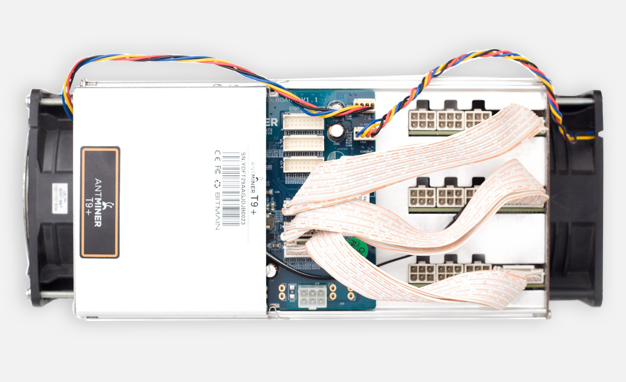
Bitcoin Mining Hashrate :
- 10 TH/s,
- 10.5 TH/s,
- 11 TH/s,
- 11.5 TH/s
- 12 TH/s
Power Consumption :
- 1406W (10TH/s batch)
- 1432W (10.5TH/s batch)
- 1432W (11TH/s batch)
- 1432W (11.5TH/s)
- 1419W (12TH/s)
Power Efficacy :
- 0.141J/GH (10TH/s batch)
- 0.136J/GH (10.5TH/s batch)
- 0.130J/GH (11TH/s batch)
- 0.125J/GH (11.5TH/s batch)
- 0.118J/GH (12TH/s batch)
Noise level : 76 db
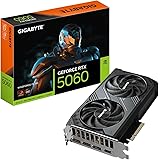
GIGABYTE GeForce RTX 5060 WINDFORCE OC 8G Graphics Card, Cooling System, 8GB 128-bit GDDR7, PCIe 5.0, Manufactured by NVIDIA, DisplayPort & HDMI - Video Output Interface, GV-N5060WF2OC-8GD Video Card
$349.99 (as of 11/03/2026 13:57 GMT +03:00 - More infoProduct prices and availability are accurate as of the date/time indicated and are subject to change. Any price and availability information displayed on [relevant Amazon Site(s), as applicable] at the time of purchase will apply to the purchase of this product.)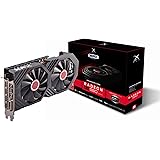
XFX Radeon RX 580 GTS XXX Edition 1386MHz OC+, 8GB GDDR5, VR Ready, Dual BIOS, 3xDP HDMI DVI, AMD Graphics Card (RX-580P8DFD6)
$219.99 (as of 11/03/2026 13:57 GMT +03:00 - More infoProduct prices and availability are accurate as of the date/time indicated and are subject to change. Any price and availability information displayed on [relevant Amazon Site(s), as applicable] at the time of purchase will apply to the purchase of this product.)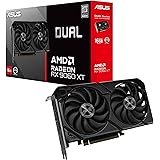
ASUS Dual Radeon™ RX 9060 XT 16GB GDDR6 Graphics Card (PCIe 5.0, HDMI 2.1b, DisplayPort 2.1a, 2.5-Slot Design, Axial-tech Fan Design, 0dB Technology, and More)
$489.99 (as of 11/03/2026 13:57 GMT +03:00 - More infoProduct prices and availability are accurate as of the date/time indicated and are subject to change. Any price and availability information displayed on [relevant Amazon Site(s), as applicable] at the time of purchase will apply to the purchase of this product.)
ASUS Prime Radeon™ RX 9070 XT OC Edition Graphics Card, AMD (PCIe 5.0, HDMI/DP 2.1, 2.5-Slot Design, Axial-tech Fans, Ball Bearings, Dual BIOS, GPU Guard)
$799.99 (as of 11/03/2026 13:57 GMT +03:00 - More infoProduct prices and availability are accurate as of the date/time indicated and are subject to change. Any price and availability information displayed on [relevant Amazon Site(s), as applicable] at the time of purchase will apply to the purchase of this product.)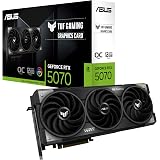
ASUS TUF GeForce RTX™ 5070 12GB GDDR7 OC Edition Graphics Card, NVIDIA, Desktop (PCIe® 5.0, HDMI®/DP 2.1, 3.125-Slot, Military-Grade Components, Protective PCB Coating, Axial-tech Fans)
$762.08 (as of 11/03/2026 13:57 GMT +03:00 - More infoProduct prices and availability are accurate as of the date/time indicated and are subject to change. Any price and availability information displayed on [relevant Amazon Site(s), as applicable] at the time of purchase will apply to the purchase of this product.)